Eyeglass Basics for Brooklyn Patients

Whether you are getting your first pair of glasses or replacing an older prescription, understanding your options can make the process easier. At Mermaid Optical, we help patients throughout Coney Island and Brooklyn choose the right eyeglasses with confidence.

This guide explains the essentials, from reading your prescription to choosing frames and lens upgrades that match your vision and lifestyle. 

A smiling couple in a cozy living room, with the woman hugging the man from behind, both wearing warm sweaters and glasses, and a plant and books in the background
A smiling elderly woman wearing glasses sits in a comfortable chair reading a book in a cozy room

What Prescription Glasses Are & How They Work 

Prescription glasses help your eyes focus light more effectively, correcting shared vision issues such as nearsightedness, farsightedness, or astigmatism. During an eye exam, your eye doctor will measure your vision and provide a prescription tailored to your needs.

Glasses help bring objects into clearer focus by adjusting how light is focused on your retina. 

How to Understand Your Eyeglasses Prescription

Your prescription will include numbers and abbreviations that describe how your lenses need to be shaped. Key parts include: 

  • Sphere (SPH): How strong your correction is for nearsightedness or farsightedness.
  • Cylinder (CYL): The amount of astigmatism correction.
  • Axis: The direction of astigmatism.
  • Add: Extra magnification for reading or close-up work.
  • PD (Pupillary Distance): The space between your pupils for accurate lens alignment.

If anything is unclear, our opticians will review the numbers with you and explain them in plain language. 

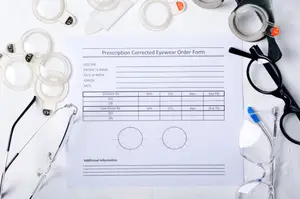
Prescription Corrected Eyewear Order Form with eyeglasses, tape dispenser, and other items on a white surface
A young woman wearing glasses and a white turtleneck shirt is writing on a whiteboard with a marker.

Types of Prescription Lenses Available

We offer several lens types. Each suited to different prescriptions and visual needs: 

  • Single vision lenses for one field of vision (distance or near) 
  • Bifocal lenses with two distinct visual zones 
  • Progressive lenses with a smooth transition for distance, intermediate, and near tasks 
  • High-index lenses that are thinner and lighter for strong prescriptions 
  • Polycarbonate lenses for children or patients needing impact resistance 

We recommend lenses based on how you use your glasses on a daily basis. 

Lens Coatings & Add-Ons That Improve Comfort

Many patients add enhancements to their lenses to improve comfort, protect the lenses, and reduce eye strain. Common options include: 

  • Anti-glare coatings to reduce reflections and glare.
  • Blue light filters to protect from digital screen exposure.
  • Photochromic lenses that darken in sunlight.
  • Scratch-resistant coatings for durability.
  • UV protection, which is built into most modern lenses.

Not every coating is necessary. We will explain which ones are useful based on your lifestyle. 

A smiling senior African American man sitting on a couch, holding a white coffee cup, wearing eyeglasses and a beige shirt, with a white wall and potted plant in the background.